AI answers · forum discussions · source checks
Check AI answers before you post
Turn an AI draft into a forum reply that readers can check. Use this guide and calculator to track your source review.
This site provides a reading guide and a local calculator. It does not generate answers or host discussions.
Start with a question people can answer
Before you ask a forum for help, state the decision you need to make. Describe the relevant context and the result you want. For a software problem, include the version, the error message, and the steps you already tried. Remove passwords and personal details from examples.
Separate your observations from your assumptions. “The export contains blank rows” describes an observation. “The software deleted my records” adds a cause that you still need to check. Ask readers which explanation fits the evidence. Give them enough detail to reproduce the problem.
Split the draft into claims
Mark each statement that a source could support or contradict. Keep a claim narrow enough to check on its own. A sentence about a product's price and supported devices contains separate claims. Put personal preferences outside your factual claim count.
For this review, classify each claim as supported, contradicted, or unresolved. Use “supported” only after you read relevant source material. Use “contradicted” when the source directly conflicts with the claim. Keep missing, ambiguous, and inaccessible evidence unresolved. An unavailable page does not establish that a claim is false.
Check the citation and the claim
A citation is a reference to a source. First, find the source independently. Match its title, author, and publication details. Then read the passage that supports the draft. Check the population, product version, location, and conditions before you reuse the result.
The National Institute of Standards and Technology, NIST AI 600-1 (2024), describes confident false output as confabulation. Its discussion includes invented citations. Its action MS-2.5-003 calls for checking sources and citations during testing and monitoring.
Use the original study for research findings. Use the manufacturer's documentation for product behavior. Write down the source title, publication year, relevant passage, and your reason for accepting or rejecting the claim. If the evidence addresses a different question, leave the claim unresolved.
Your counts, calculated locally
AI answer source coverage calculator
Count the factual claims in your draft. Enter how many you supported and contradicted through manual review. Each claim belongs in only one group. The calculator shows your progress; it does not inspect an answer or visit sources.
Enter whole numbers from 0 to 10,000. Supported plus contradicted claims cannot exceed the total.
Method: supported coverage = supported ÷ total × 100. Reviewed coverage = (supported + contradicted) ÷ total × 100. Unresolved = total − supported − contradicted. Percentages use one decimal place. No percentage applies when the total is zero.
These are arithmetic measures of your classifications, not a truth score or a NIST assessment. The tool uses your browser without sending the counts. Reloading restores the example. Review contradicted claims before posting, even when reviewed coverage reaches 100%.
What the citation research shows
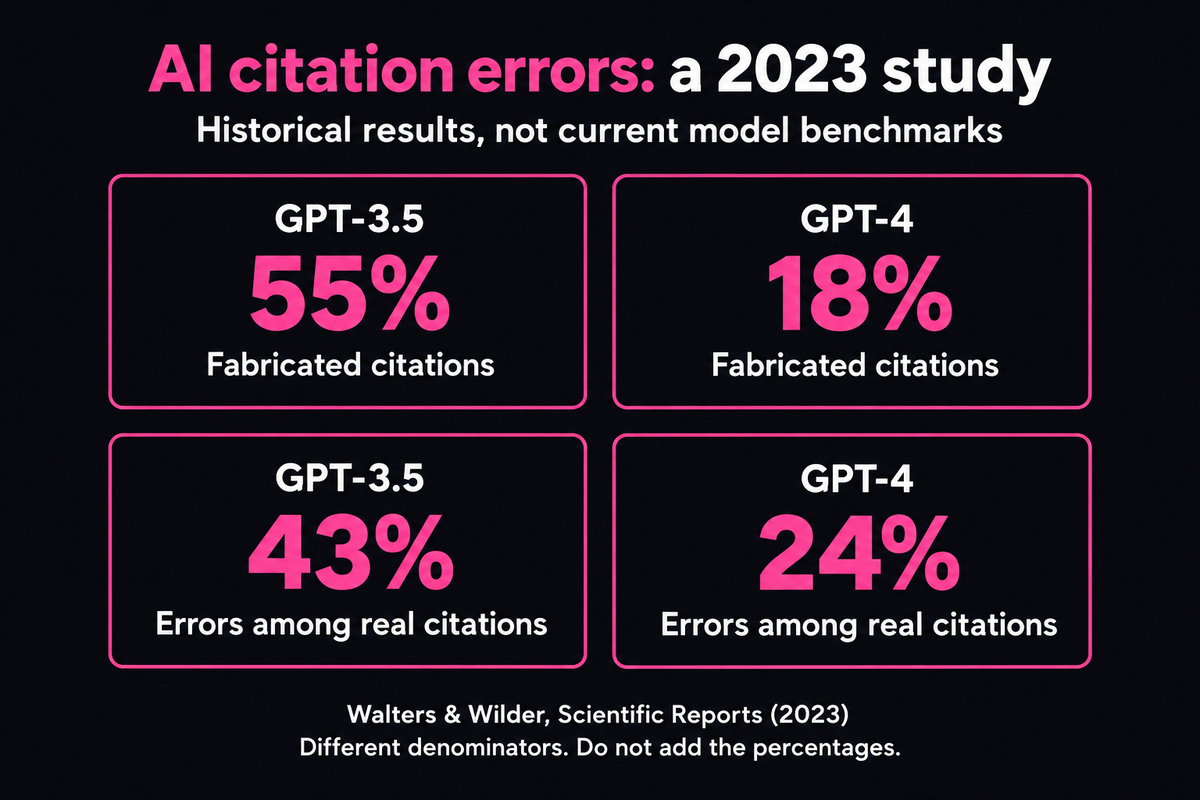
Walters and Wilder's Scientific Reports study (2023) examined ChatGPT citations. In their sample, fabricated citations accounted for 55% with GPT-3.5 and 18% with GPT-4. Among real citations, 43% and 24%, respectively, contained substantive errors.
The fabrication percentages describe all citations within each model's sample. The error percentages describe only real citations. Do not add these rates. They describe the study's historical setup, not the accuracy of today's systems or your draft.
Make your forum reply easy to check
Lead with the answer your evidence supports. Put the source beside the relevant claim. Explain what you tested yourself and what you learned from a document. Keep unresolved points visible instead of filling the gaps with confident wording.
When you correct a reply, state which claim changed and why. Keep enough context for later readers to understand the discussion. If a source disagrees with your experience, describe the difference and invite a reproducible example. Avoid turning a personal result into a universal rule.
Sources for this guide
NIST, Artificial Intelligence Risk Management Framework: Generative Artificial Intelligence Profile (2024), section 2.2 and action MS-2.5-003.
William H. Walters and Esther Isabelle Wilder, Fabrication and errors in the bibliographic citations generated by ChatGPT, Scientific Reports (2023). DOI: 10.1038/s41598-023-41032-5.